
Dominican Republic in September: Weather, Low Season and the Best Regions to Visit
Backpacks are packed away, kids are back in the classroom, and the family schedule has settled back into its routine. For a lot of travelers, that's exactly the moment the urge to get away kicks in: summer vacation is over for everyone else, not necessarily for you. September marks the start of the Dominican Republic's low season, and that changes the experience the moment you step off the plane, whether you land at Punta Cana International Airport (PUJ) or Las Américas International Airport in Santo Domingo (SDQ). Here's how to make the most of this window: where to go, what to do, and how to put together a flexible road trip.
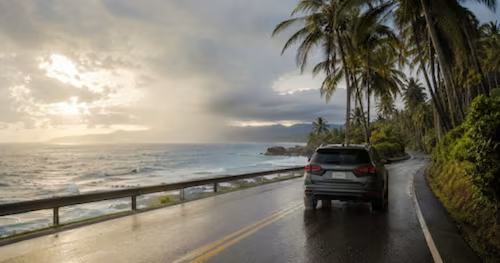
September, the perfect getaway right after back-to-school
In the United States and Canada, back-to-school marks the return to routine for families with kids every year. For everyone else, it marks the start of a particularly good window to travel: Dominican beaches, roads, and restaurants settle into a calmer pace, rental car and lodging rates become more affordable again, and rental agencies have more time to help plan a tailor-made itinerary.
Who benefits most from this timing?
This window is especially good for couples without school-age kids, young professionals who can take time off outside the summer rush, grandparents traveling with grandchildren too young for school, and remote workers who have more flexibility with their dates. Families dealing with staggered school calendars or a later start date benefit too.
Low season: A real advantage beyond just fewer crowds
September kicks off the Dominican low season, which runs through the fall: fewer crowds at tourist sites and on the roads, but also less pressure across the entire trip-planning chain. Lodging rates become more affordable, restaurants stop requiring reservations across the board, and the vehicle categories in highest demand during peak season , SUVs, family vehicles, 7-seaters, are widely available again. It's a real advantage for a more relaxed pace of travel, without the peak-season lines.
At the Punta Cana and Santo Domingo airports: The low season advantage in practice
The low season is felt most directly the moment you land. At the Jumbo Car counters at Punta Cana International Airport (PUJ) and Las Américas International Airport in Santo Domingo (SDQ), wait times are noticeably shorter than in December-April or during peak summer: staff have more time to walk you through your options, compare vehicle categories, and recommend an itinerary suited to the current weather. Fleet availability is broader too, which improves your odds of getting the category you want, or even a free upgrade, and gets you on the road faster after a long-haul flight. The downtown Santo Domingo agency (Abraham Lincoln) rounds out the network for travelers already based in the capital who skip the airport altogether.
What's the weather really like in the Dominican Republic in september?
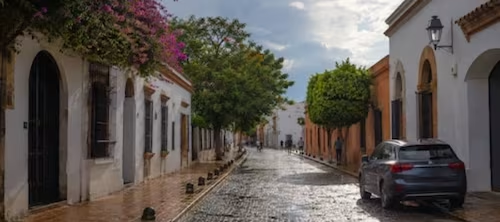
September sits right in the middle of tropical season: daytime temperatures stay high, typically in the low-to-high 80s°F (around 27-32°C), with high humidity. Sea temperatures stay warm across nearly the entire country, which still makes it a great month for water activities.
Frequent showers, but rarely a washed-out day
Rain is generally more common than during peak season (December through April), but it usually shows up as short, intense tropical downpours late in the day rather than steady rain all day long. It's entirely possible to enjoy a sunny morning at the beach, get caught in a late-afternoon shower, and see clear skies again by evening. The key is keeping your plans flexible instead of building the whole day around a single outdoor activity.
Punta Cana, Santo Domingo, Samaná, the north coast: How the regions differ
The Dominican Republic is a small country, but its varied terrain means September weather plays out very differently depending on where you're staying. Before picking a home base, it helps to know what to expect region by region — and which type of traveler each one suits best.
Punta Cana: The safe bet, in a quieter version
The region stays the most popular for beach tourism, but noticeably less crowded than during peak season: fewer people on the beaches, more availability at restaurants and for excursions. Showers here tend to be brief, usually concentrated late in the afternoon, which leaves mornings and early afternoons largely clear. It's also an excellent base for day trips by car to La Romana, Bayahibe, or Higüey on days when the sky looks less certain without giving up the beach altogether.
Santo Domingo: The city that isn't at the mercy of the weather
The capital remains the most reliable destination no matter the forecast. The Colonial Zone, a UNESCO World Heritage Site, along with its museums, galleries, and restaurants offer plenty of indoor options, on top of outdoor strolls on the days the weather cooperates. It's also the logical starting point for pairing a cultural getaway with a day trip inland or along the coast, without depending entirely on the weather window.
Samaná: Rainier, but that works in its favor

The peninsula is naturally the rainiest region in the country in September, thanks to its mountainous terrain, which catches humidity coming off the ocean. That extra rain actually benefits the waterfalls, El Limón in particular is especially spectacular this time of year thanks to a stronger flow of water, and the vegetation is at its greenest. On the flip side, the secondary roads leading to the most remote beaches, like Playa Rincón, call for extra caution after heavy rain: it's worth building in extra time and choosing a vehicle with enough ground clearance.
The north coast: Wind, surf, and weather close to the national average
Puerto Plata, Sosúa, and Cabarete see weather fairly similar to the rest of the country in September, though with somewhat stronger winds at times, a plus for kitesurfing and windsurfing fans. It's an interesting region for a more low-key coastal road trip, with less crowding than Punta Cana and a more local feel.
Which region fits which type of traveler?
In short: Punta Cana suits travelers who want the beach without peak-season crowds, Santo Domingo suits culture and food lovers who don't want to be at the mercy of the weather, Samaná suits nature lovers chasing dramatic waterfalls, and the North Coast suits those looking for a more authentic, less crowded road trip. And of course, nothing stops you from combining several of these regions in one trip with a flexible, self-driven itinerary.
Which airport should you fly into: PUJ or SDQ?

This choice mostly comes down to your itinerary. Punta Cana International Airport (PUJ) is the most direct option for exploring the east coast: Punta Cana, La Romana, Bayahibe, and, further north, the Samaná peninsula. Las Américas International Airport in Santo Domingo (SDQ) is better positioned for a trip centered on the capital, the southwest, or the interior mountains around Jarabacoa. There's also nothing stopping you from flying into one and departing from the other: during low season, all three Jumbo Car locations, PUJ, SDQ, and downtown Santo Domingo, have more availability to support that kind of point-to-point itinerary.
Hurricane season: How to stay informed without getting anxious
September statistically marks the peak of hurricane season across the Atlantic and the Caribbean, which runs roughly from June through November. It's a topic that comes up often with travelers, and it deserves a clear explanation rather than being avoided altogether.
What “hurricane season” actually means
Most of the activity during this stretch shows up as tropical waves and passing rain systems, responsible for the showers described above, far more often than as a major hurricane making direct landfall. A system can take several days to develop from a tropical wave into a tropical storm and then a hurricane, and weather agencies track that progression well in advance, which in practice gives travelers several days of visibility before any real threat materializes. The vast majority of September trips go off without any direct impact at all.
Before you go: Smart habits
Check the 5-7 day forecast through the Dominican Republic's National Meteorological Office (Onamet) and the U.S. National Hurricane Center (NHC), both of which track tropical activity in the region continuously. Check the cancellation or change policies on your flight and lodging, and consider travel insurance that covers weather-related disruptions if possible. Booking your rental car ahead of time while keeping some flexibility around your dates is the best combination for this time of year.
During your trip: Staying informed without letting it take over
A quick daily check of Onamet's bulletins or a reliable weather app is more than enough, there's no need to check forecasts constantly, just keep an eye on the general trend, especially before hitting the road for a new leg of the trip. If a real alert is issued (a tropical storm or hurricane watch/warning), Dominican authorities communicate early and clearly, with specific guidance for the affected areas.
What the Jumbo Car team does in the event of an alert
If weather conditions are confirmed to be deteriorating, the Jumbo Car agencies in Santo Domingo (SDQ and downtown) and Punta Cana (PUJ) can help adjust your itinerary, recommend a vehicle better suited to the conditions, or point you toward less exposed routes. The goal isn't to make a big deal out of a period that, most of the time, is entirely travel-friendly, it's to give travelers the tools to head out with confidence and adapt if needed.
What to do in the Dominican Republic in september
Cultural visits to the Colonial Zone in Santo Domingo, local markets, inland food routes (cacao, coffee), and mountain waterfall excursions are all a great fit for this time of year, along with short morning strolls along the coast. On the rainier days, it helps to have one or two indoor backup options ready, a museum, a food-focused workshop, a covered market, rather than betting everything on the beach.
How to build a flexible road trip
The key to a successful September road trip is flexibility: keep drives to two or three hours max between stops, build in a buffer day with no fixed plans, and check the weather and road conditions each morning before heading out.
SDQ, Downtown, or PUJ: Where should you start your road trip?
This is often the first decision to make. Jumbo Car's three locations, Santo Domingo's airport (SDQ), downtown Santo Domingo (Abraham Lincoln), and Punta Cana's airport (PUJ), let you build either a loop itinerary or a point-to-point one, depending on what you're after, without having to double back to the same spot every time. During low season, that flexibility is even easier to come by: agencies have more open slots for picking up at one airport and dropping off at another, saving you from backtracking just to return the car.
Returning your vehicle at a different agency
An itinerary that starts at PUJ to explore the east coast can easily wrap up at SDQ after a stop in Santo Domingo — or the other way around. This option, harder to guarantee during peak season due to limited availability, becomes a real perk in September: it lets you build a linear route instead of a round trip, taking full advantage of Jumbo Car's presence at both of the country's airports.
Which vehicle should you choose for a september trip?
For a trip focused entirely on Santo Domingo or Punta Cana, a compact car is plenty. Once your itinerary includes the interior, the Samaná region, or secondary roads, an SUV or 4x4 is recommended: higher ground clearance and better traction make driving easier on roads that can get slick after a downpour. It's also worth checking the wiper blades and tires when you pick up the vehicle — a simple habit that pays off during rainy season.
No, but it's a good idea to follow weather bulletins before and during your trip, and to favor flexible bookings, especially during the peak of hurricane season.
September isn't the driest month of the year in the Dominican Republic, but it's one of the most interesting times to travel right after back-to-school: fewer crowds, better rates, especially lush scenery inland, and more available PUJ and SDQ agencies ready to help plan a custom itinerary the moment you land. With a flexible route and the right vehicle, rainy season becomes an easy thing to plan around rather than an obstacle.
Check vehicle availability in Punta Cana and Santo Domingo for September, and start planning your low-season road trip with Jumbo Car.
No, but it's a good idea to follow weather bulletins before and during your trip, and to favor flexible bookings, especially during the peak of hurricane season.
Not necessarily, but showers are usually brief and localized. A flexible itinerary with a couple of indoor backup options lets you make the most of your trip even on rainier days.
It's not a requirement, but it's a real advantage: fewer crowds, better rates, and more availability all around, which makes it a particularly good window for couples, flexible travelers, and families whose school calendar allows for it.
Not for a trip limited to Santo Domingo or Punta Cana. That said, an SUV or 4x4 is recommended as soon as your itinerary heads inland or into the Samaná region.
Even though it's a quieter period than peak season, it's still worth booking your vehicle ahead of time to lock in the category you want and get the best available rates.
Yes — and that's actually one of the perks of low season: the PUJ and SDQ counters see less demand than during peak season, which means shorter wait times and a wider fleet available across every vehicle category.
Yes, between the PUJ, SDQ, and downtown Santo Domingo agencies, and it's easier to arrange during low season. It lets you build a point-to-point itinerary instead of a round trip back to the same agency.
