
How much does a 7-day road trip in the Dominican Republic cost?
Before booking flights and a rental car, one question comes up often: how much should you budget for a 7-day road trip in the Dominican Republic?
The answer depends mainly on four factors: vehicle category, distance traveled, number of travelers and travel style.
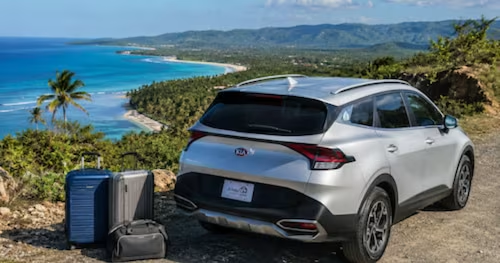
Rental car, gas, tolls and parking make up the core road-trip expenses. Meals, accommodations and activities then add to the overall vacation budget.
To make these estimates more useful, this guide uses a typical seven-day driving itinerary as a reference. The amounts below are estimates only: rental rates, fuel prices, exchange rates and certain fees may change.
Already know your travel dates? Check the actual rate for your stay and preferred vehicle category.
Which route is used for the cost estimate?
To compare expenses consistently, we use a route of approximately 530 miles / 850 km connecting several major regions:
Punta Cana → Santo Domingo → Southwest → Jarabacoa → Samaná → Punta Cana
This distance is used only as a budgeting reference.
A shorter trip focused on Punta Cana, Bayahibe, La Romana and Higüey will naturally require less gas and fewer tolls.
By contrast, an itinerary including Barahona, Pedernales, Jarabacoa or Samaná involves longer distances and may require more planning.
1. Rental car cost
The rental car is generally the largest part of your driving budget. However, the price is not fixed: it depends on factors such as your travel dates and rental period, the vehicle category you choose, the pickup location, and the insurance and protection options selected. Additional equipment and vehicle availability at the time of booking can also affect the final rate.
Estimated rates for 7 days
Vehicle Category | Estimated Daily Rate* | Estimated 7-Day Cost* |
Economy / compact | $25–$35 | $175–$245 |
Family car / compact SUV | $40–$55 | $280–$385 |
SUV / 4WD | $55–$75 | $385–$525 |
Van / 7-passenger vehicle | $70–$95 | $490–$665 |
* Estimated ranges to verify before publication and not guaranteed rates. The final amount depends on the Jumbo Car booking engine and the conditions applicable to your travel dates.
These estimates may not include:
optional protection packages;
child seats;
additional drivers;
special equipment;
fees linked to specific rental conditions.
Good rule of thumb
Do not compare only the advertised daily rate.
Instead, look at:
total rental price + protection options + the extras you actually need.
2. How much should you budget for gas?
Gas is usually the second major road-trip expense.
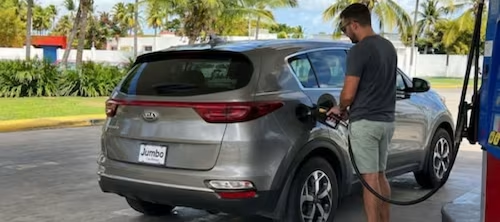
For a distance of approximately 850 km (530 miles), fuel costs will depend mainly on the vehicle you choose and its fuel consumption, as well as traffic conditions, air-conditioning use, and any additional detours you make during the trip.
Estimated fuel cost by vehicle category
Vehicle Category | Estimated Fuel Economy | Estimated Weekly Gas Cost |
Economy car | approx. 7 L/100 km | $75–$90 |
Compact SUV | approx. 8.5 L/100 km | $90–$110 |
Larger SUV / 4WD | approx. 10.5 L/100 km | $110–$135 |
7-passenger van | approx. 11.5 L/100 km | $125–$150 |
These amounts should be recalculated using current gas prices at the time of travel.
Because fuel prices can change, it is better to use the current weekly price rather than leave one fixed amount in the article indefinitely.
How can You reduce fuel costs?
To reduce fuel consumption, start by choosing a vehicle that actually fits your trip. For two people traveling with light luggage and driving mainly on major roads, a compact car may be more practical and fuel-efficient than a large SUV.
It also helps to organize your activities by area. For example, group several stops in Santo Domingo into the same day instead of driving back and forth to your hotel multiple times. On longer drives, maintain a steady speed whenever possible and avoid unnecessary detours.
Before heading out, take a few minutes to check your route in your navigation app. A little planning can help you avoid unnecessary miles and better manage your fuel budget.
3. How much should you budget for tolls?
Tolls usually represent a relatively small portion of the road-trip budget.
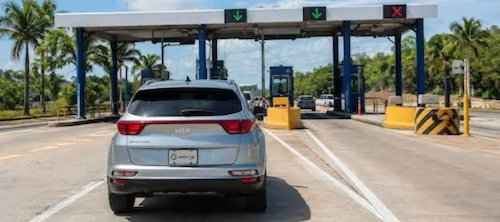
Depending on the itinerary, travelers may use highways such as:
Autopista Las Américas;
Autopista Duarte;
Autopista del Coral;
Autovía del Nordeste.
For a roughly 530-mile / 850-km trip covering several regions, a budget of approximately $12–$20 can be used as a planning estimate.
The actual amount depends on the route you choose.
Jumbo Car tip
Keep small Dominican peso bills in the car to make toll payments easier.
For a specific route, identify the toll booths before leaving.
4. Parking: A small expense worth remembering
At many hotels and accommodations, parking is free or included.
For one week, a budget of approximately $15–$30 can be reasonable if your itinerary includes several urban stops.
Again, this is only an estimate.
A beach-focused itinerary may cost less, while several days in Santo Domingo could increase this expense.
5. How much should you budget for meals?
Meal costs depend much more on travel style than on the rental car.
Prices can vary significantly between:
local Dominican restaurants;
tourist-oriented restaurants;
beachfront establishments;
hotel restaurants;
quick meals during driving days.
As a general reference, the original budget uses approximately $30–$50 per traveler per day, or:
For 7 days
$210–$350 per person
This amount may cover regular meals and some snacks, but it should always be presented as an estimate.
Dominican foods to try along the way
Use your road trip to try:
mangú;
sancocho;
pollo guisado;
grilled fish;
tostones;
rice and beans;
tropical fruit.
Travelers can often reduce food expenses by choosing local restaurants rather than eating exclusively in major tourist areas.
6. Economy car, family car, SUV or van: How does the choice affect your budget?
Choosing the right rental car does not always mean choosing the cheapest one.

Economy car
A good option for:
two travelers;
limited luggage;
Punta Cana;
Santo Domingo;
La Romana;
major paved roads.
Advantage
Usually lower rental and fuel costs.
Family Car or Compact SUV
A practical option for:
families of three to five;
several suitcases;
multi-day road trips;
longer driving distances.
Advantage
More passenger and luggage space without automatically moving to a very large vehicle.
SUV or 4WD
Consider one when your itinerary genuinely includes:
specific secondary roads;
unpaved access roads;
difficult hotel access;
destinations where current local conditions make it useful.
A 4WD vehicle is not automatically required to visit Jarabacoa, Samaná or the southwest.
The decision should depend on the exact road and current conditions, not simply on the destination name.
Van or 7-passenger vehicle
Particularly useful for:
five to seven travelers;
larger families;
groups of friends;
substantial luggage.
The total rental price is higher than an economy car, but the cost per person may become more attractive when several people share the vehicle.
Not sure whether you need an economy car, SUV or 7-passenger vehicle? Compare Jumbo Car categories based on your group size, luggage and itinerary.
Button: Compare Vehicle Categories
7. Estimated budget for 2, 4 or 6 travelers
To make the comparison easier, here are three scenarios based on the assumptions above.
Group | Typical vehicle | Vehicle +road cost / week* | Cost per person, excluding meals* |
2 travelers | Economy car | approx. $277–$386 | approx. $140–$195 |
4 travelers | Family car / SUV | approx. $397–$546 | approx. $100–$140 |
6 travelers | 7-passenger van | approx. $642–$866 | approx. $110–$145 |
* Rental + gas + tolls + parking. Estimates vary by travel dates.
The table highlights an important point:
A larger vehicle costs more overall, but the transportation cost per traveler may decrease when shared by a group.
For families and groups, one correctly sized vehicle may also be easier than renting two smaller cars:
one route to follow;
one fuel stop;
one parking space;
one vehicle to manage.
8. Estimated total budget including meals
Adding approximately $210–$350 per traveler for meals gives the following planning ranges:
Group | Per Person Excluding Meals | Including Estimated Meals |
2 travelers | $140–$195 | approx. $350–$545 |
4 travelers | $100–$140 | approx. $310–$490 |
6 travelers | $110–$145 | approx. $320–$495 |
These amounts do not include:
airfare;
accommodations;
excursions;
activities;
personal purchases;
travel insurance.
They are intended only to illustrate the road-trip transportation and meal budget.
9. Why can these costs change?
Any road-trip budget calculated several weeks before departure should include some flexibility.
The main variables include:
Travel dates
Rental rates may change depending on demand.
Gas prices
Fuel prices may be revised regularly.
Exchange rates
Conversions between Dominican pesos, U.S. dollars, Canadian dollars or other currencies can fluctuate.
Rental options
Child seats, additional drivers or optional protection may change the final rental price.
Dining style
Two travelers following the same road trip can spend very different amounts depending on where they eat.
How can you build your own road trip budget?
A simple formula can help:
Vehicle budget
Rental + gas + tolls + parking
Then:
Cost per traveler
Vehicle budget ÷ number of travelers
Finally:
Overall road trip budget
Cost per traveler + meals + accommodations + activities
This approach is more useful than presenting one fixed amount as if it applied to every traveler.
So, how much should you budget for 7 days?
There is no single budget that applies to every Dominican Republic road trip.
For a seven-day trip, the main expenses to anticipate are:
rental car;
gas;
tolls;
parking;
meals.
An economy car can keep costs down for a couple, while a family car, SUV or van may make more sense when several travelers share the cost.
The most important point is to treat the figures in this guide as planning estimates, not guaranteed prices.
For the actual rental amount, always start with your exact travel dates.
For two travelers sharing an economy car, using a relatively simple itinerary and choosing local restaurants, the road, vehicle and meal budget may start at a few hundred dollars per person. The actual amount depends on travel dates and individual choices.
Protection and rental conditions depend on the option selected. Review the details in the booking engine to see exactly what is included and which additional protections are available.
No. An economy or family-size vehicle may be sufficient if your itinerary remains mainly on major paved roads. Choose an SUV or 4WD only when space, luggage or the specific access roads justify it.
Usually not. On a seven-day road trip, tolls are typically much lower than the combined cost of rental and gas.
Choose a vehicle that fits your needs rather than an oversized model, plan your stops carefully and avoid unnecessary backtracking.
