
Driving in the rain in the Dominican Republic: 10 tips to stay safe on the road
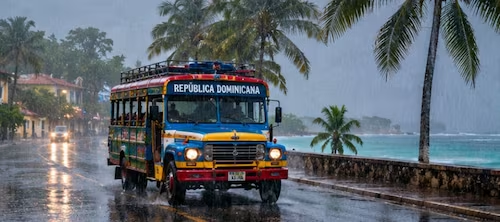
Flying down to the Caribbean between May and November is a promise of a great escape. The landscapes are a brilliant green, the weather is hot, and the island hums with energy. But if you’re traveling during the wet season, one question comes up again and again: how do you handle driving in the rain in the Dominican Republic when a tropical downpour catches you on the road?
It’s only natural to wonder about the Dominican Republic’s weather before you get behind the wheel. Tropical rain is nothing like a gray, all-day drizzle in Seattle: it usually comes as a short, intense cloudburst that can be heavy for a few minutes, then clears up just as quickly.
At Jumbo Car, we want to put your mind at ease: a tropical shower won’t ruin your vacation if you know the right moves and drive a recent, well-maintained vehicle. Here’s our complete guide to handling wet roads in the Dominican Republic and across the island of Hispaniola.

🌧️ 1. Dominican Republic weather: Understanding the rainy season
To travel with peace of mind, it helps to understand how the seasons work. The island enjoys a warm tropical climate all year round, moderated by the trade winds.
Dominican Republic weather and seasons at a glance
Period | Season | What to expect |
|---|---|---|
December to April | Dry season | Maximum sunshine, little rainfall |
May to November | Rainy season | Short, heavy, warm showers, mostly in the afternoon |
June to November (peak August–October) | Hurricane season | Risk of tropical waves, storms and hurricanes; isolated squalls |
↳ When to visit the Dominican Republic and what to expect during the rainy season
If you’re wondering when to visit the Dominican Republic, there’s no “bad” time, just different vibes. From May to November, the island goes through the Dominican Republic’s rainy season, which largely overlaps with the Atlantic hurricane season (officially June 1 to November 30, the same calendar Floridians and Gulf Coast residents know well).
So what does that look like on the ground? It rarely rains all day. The sun usually shines in the morning, then storm clouds build up with the afternoon heat and trigger a dramatic 30-minute downpour before blue skies return. All-day rain is mostly tied to a passing tropical wave or tropical storm, which forecasters announce several days in advance.

↳ The rainy season in Punta Cana vs. the rest of the island
The island’s geography creates very distinct microclimates. The rainy season in Punta Cana, on the far eastern tip, is much milder than in the north (around Samaná or Puerto Plata) or in the mountains of the Cordillera Central: showers there are usually short and dry up fast in the heat. And if a downpour disrupts your beach plans, your rental car becomes the perfect plan B. Check out our ideas in our article “What to Do in Punta Cana When It Rains”
🛑 2. Driving in the rain in the Dominican Republic: 10 tips
When the sky suddenly darkens over the highway, defensive driving is key. Driving in the Dominican Republic in a downpour calls for extra attention, because the roads have their own quirks: unmarked speed bumps, lots of motorcycles, and pavement that can be uneven. Here are our tips for staying in control in the rain, as well as in the fog on mountain roads.
↳ 1. Slow down right away (and know the actual limits)
Keep in mind that speed limits and road signs in the Dominican Republic are posted in kilometers per hour, not miles per hour. On major highways (such as the Autopista Duarte or the Autovía del Este), limits are generally 80 to 100 km/h, roughly 50 to 62 mph (up to 120 km/h, about 75 mph, on some newer stretches), and drop to 40 km/h (25 mph) in towns. In heavy tropical rain, forget those maximums! Slow down to 50–60 km/h (30–37 mph) on the highway and under 30 km/h (about 20 mph) in town. The asphalt, baking hot before the storm, releases oil residue that turns into a very slippery film with the first drops. For all the local rules of the road, see our guide to driving in the Dominican Republic.
↳ 2. Increase your following distance
On wet pavement, stopping distances can double. Keep at least 4 to 5 seconds between you and the vehicle ahead. This is especially important behind guaguas (local public minibuses) and cargo trucks, which stop often and abruptly, without always using their hazard lights or turn signals.
↳ 3. Turn on your low beams (rain, fog and hazard lights)
Visibility can drop dramatically in a tropical squall. Switch on your low beams right away so other drivers can see you. On mountain roads, especially toward Jarabacoa, Constanza or the Cordillera Central, rain often comes with thick fog: use your fog lights if the vehicle has them, follow the road markings and slow down even more.
Golden rule in the DR: don’t drive with your hazard lights on! In the Dominican Republic, locals often use them to signal that they’re about to stop or that there’s an obstacle in the lane. Only turn them on if you have to come to a complete stop.
↳ 4. Watch out for “policías acostados” and other road hazards
Giant speed bumps, known locally as policías acostados (literally “sleeping policemen”), are everywhere as you approach villages (for example on the road from Higüey to Bávaro or the coastal road to Las Terrenas). They’re rarely painted and barely signposted. In heavy rain, standing water forms large, murky puddles that hide these bumps, along with deep potholes and open storm drains. Never drive fast through a puddle unless you know how deep it is.
↳ 5. Beware of hydroplaning on major highways
Modern highways drain well, but water can pool quickly in dips in the road. If your steering suddenly feels light (loss of traction), don’t slam on the brakes! Stay calm, ease off the gas gradually and hold the wheel steady in a straight line until your tires regain their grip.
↳ 6. Never try to cross a “Cañada” or a flooded road
In rural or mountain areas (particularly in the north toward Samaná and Puerto Plata, or in the Cordillera Central), streams that are normally dry (cañadas) can turn into torrents within minutes during a storm. If the road is covered by fast-moving brown water and you can no longer see the road markings, do not attempt to cross under any circumstances, even in an SUV. As the U.S. National Weather Service puts it: turn around, don’t drown. Wait 15 to 20 minutes on higher ground: tropical flash floods often recede as fast as they rise.
↳ 7. Stay extra alert around motorcycles (Motoconchos)
Motorcycles, including motoconchos (motorcycle taxis), make up a huge share of Dominican traffic. As soon as the rain gets heavy, riders rush to take shelter under highway overpasses, footbridges or large trees, sometimes stopping right in the right-hand lane or on the shoulder. Slow down as you approach overpasses and keep a close eye on your mirrors.
↳ 8. Use your A/C to clear fog instantly
In the tropics, the contrast between the warm, humid air inside the car and a windshield cooled by the rain creates thick fog on the glass within seconds. Switch your Jumbo Car vehicle’s A/C to defrost with cool air, and your windows will be clear again in no time.
↳ 9. In an extreme downpour: Know where to pull over safely
If the rain gets so heavy that your wipers can’t keep up, don’t take any unnecessary risks. Pull over somewhere safe and sheltered:
At a gas station (such as Sunix, TotalEnergies or Texaco along the main highways, which often have well-stocked convenience stores).
In the parking lot of a large supermarket or a parada (roadside rest stop).
What to avoid at all costs: never park under a coconut palm or a large tree during a storm, because of the risk of falling branches, coconuts or power lines.
Before you head out, especially during hurricane season, check the forecasts from the Dominican Republic’s national weather office (ONAMET) and any alerts from the Emergency Operations Center (COE). The National Hurricane Center (NOAA) also tracks Caribbean storms, and Waze and Google Maps flag closed or flooded roads in real time.
↳ 10. Choose a thoroughly inspected vehicle from Jumbo Car
Your safety in the rain depends on the mechanical condition of your car. At Jumbo Car Dominican Republic, our entire fleet (compacts, sedans and SUVs) goes through strict checks before every rental: tire tread depth for maximum water evacuation, wiper blade condition and properly working ABS brakes. And if anything unexpected happens on the road, our team is just a call away to help.
🛡️ 3. Why rent an SUV in the Dominican Republic during the rainy season?
A compact car is perfectly fine for city driving in the dry season, but renting an SUV (such as a Hyundai Tucson, Kia Sportage or similar) is the best choice for a road trip during the rainy season.
↳ Higher ground clearance
An SUV’s ride height protects you from temporary standing water on the road and lets you handle uneven pavement caused by runoff with ease. Keep in mind, though: it does not make it safe to drive through a flooded road (see tip #6).
↳ Better visibility
Sitting higher above traffic lets you spot slowdowns much earlier, identify areas where water is pooling and keep a clear view of the road, even when spray from other vehicles is intense.
Driving in the rain in the Dominican Republic: The open road is yours!
Driving in the rain in the Dominican Republic is nothing to be afraid of. With smooth driving, a safe following distance and a reliable Jumbo Car SUV, tropical showers will just be short, spectacular interludes in your trip. To plan the rest of your itinerary, check out our guide to budgeting your road trip .
Book your car today and set out to explore the island with total peace of mind!
Yes, as long as you adjust your driving. Showers are usually short: by slowing down, increasing your following distance and avoiding flooded areas, you can get around with confidence. In very heavy rain, the safest move is to take a 20- to 30-minute break somewhere sheltered while the storm passes.
Historically, the months with the most rainfall are May, September and October. The rest of the wet season usually brings plenty of sunny breaks between showers. To plan your trip, read our article on Dominican Republic weather in September
Follow ONAMET bulletins and COE instructions, avoid any non-essential travel during the alert and never drive while a storm is passing through. Park your vehicle in a sheltered spot, away from trees and flood-prone areas, and contact the nearest Jumbo Car location to adjust your reservation if needed.