
Monkeys in Costa Rica: Types, Habits, and Where to Spot Them
Wondering what animals you can spot in Costa Rica, and more specifically, which monkeys call this country home? With lush rainforests, national parks, and protected reserves, this country is one of the best places in the Americas to watch primates in their natural habitat. From noisy howlers waking you up at sunrise to curious capuchins stealing snacks on the beach, monkeys are part of the daily soundtrack of Costa Rica.
In this guide, I’ll cover the different monkey species you can find here, the best spots to see them (from Manuel Antonio to Corcovado and beyond), and a few tips on how to watch them responsibly without disturbing their habitat. I’ll also share a couple of funny moments from my own encounters, because yes, they really do like to unzip backpacks.
Planning to go monkey-spotting? Many of the best reserves and national parks are spread across the country, so renting a car in San José or Liberia gives you the freedom to explore at your own pace and maximize your chances of seeing these playful primates in the wild.
Where to see monkeys in costa rica ?
Monkeys in Costa Rica can be found all over the country. However, the most concentrated populations are found in the rainforests of the Central Valley, Corcovado National Park, Osa Peninsula, Monteverde Cloud Forest Biological Reserve and Cahuita National Park. These areas provide an ideal habitat for these primates with plenty of food.

Best places to see them ?
The Osa Peninsula is the best place to see monkeys in Costa Rica and Corcovado National Park is the only park in Costa Rica where you can see all 4 monkeys !
Are the monkeys in costa rica friendly ?
Monkeys are a big part of Costa Rica's landscape and culture. There are several species of monkey that inhabit the country, including spider monkeys, squirrel monkeys, and howler monkeys. The best way to get an up-close look at these amazing creatures is to go on a guided tour with an experienced guide who can help you find them
Monkeys are among the best things to do in Costa Rica.

What kind of monkeys are in Costa Rica ?
Spider Monkey,
Howler Monkey,
Squirrel Monkey
Capuchin Monkey.
Howler Monkey in Costa Rica
No need to wake up in the morning; the cries of these monkeys will wake you up at dawn.
Named for their howls that can be heard up to 5 km away, they are certainly the loudest monkeys. It is the males that have an enlarged hyoid bone that allows them to amplify their cries for miles. They howl to communicate within the troop.
Although there are nine species of howler monkeys, it is the mantled howler that inhabits Costa Rica. Howler monkeys are easy to find in many parts of Costa Rica, especially in Guanacaste, they are the largest monkeys in Costa Rica, with males averaging 1 meter long with a tail that long and weighing up to 10 kg.
Because they have a folivorous diet, which means they eat mostly leaves, they don't move around as much as other monkeys. They sleep a lot to digest the leaves so they can survive in the heat.

Spider monkeys
These acrobats can weigh more than 2 kg and are generally about 1m50 tall.
Unfortunately, due to poaching as well as loss of habitat and food resources due to human activity, these magnificent animals have been pushed into deeper areas of the forest.
Spider monkeys are the most intelligent monkey species in Costa Rica. Their muscular, prehensile tails can support the entire weight of the animal, and with their long, slender arms, they move gracefully through the canopy in search of fruit, seeds and leaves.

Squirrel or Tití monkeys
The fourth and smallest species of monkey in Costa Rica is also called the titi monkey. It inhabits the tropical forests of the central and southern Pacific coastal areas, from Manuel Antonio to the Osa Peninsula. The small size of this monkey, its expressive face and playful behavior make it a pleasure to observe. They move through the canopy in groups, feeding on fruits, flowers, leaves, insects, lizards and frogs.
There are two subspecies:
The black-crowned squirrel monkey, which inhabits the forests of southern Costa Rica, as far west as Panama.
The grey-crowned squirrel monkey, which is endemic to the area between Quepos and the Rio Terraba.
Both subspecies are considered endangered and are increasingly difficult to see.
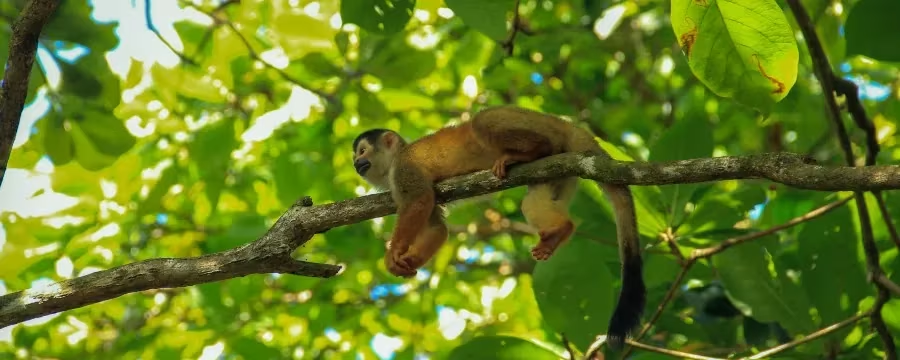
A squirrel monkey
White faced monkeys or Capuchin
White-faced capuchin monkeys are easily observed in Costa Rica. They live in groups of 5 to 24 animals. These monkeys are extremely curious, agile and aggressive. They defend their territory by threatening with their sharp teeth and by flapping on trees.
They feed mainly on fruit. Capuchin monkeys are particularly fond of bananas. If you dare to refuse them, they can get very nasty.
Despite their cute appearance, these little rascals are actually very efficient predators. Their main diet is fruits and leaves, but they also eat insects and lizards, birds and their eggs, and even baby coati. These intelligent animals work in tandem to hunt squirrels and squirrel monkeys, and have been known to use tools to open oyster shells or kill poisonous snakes.
So be careful with your stuff; they can steal it in a heartbeat !

A white faced monkey
How to deal with monkeys
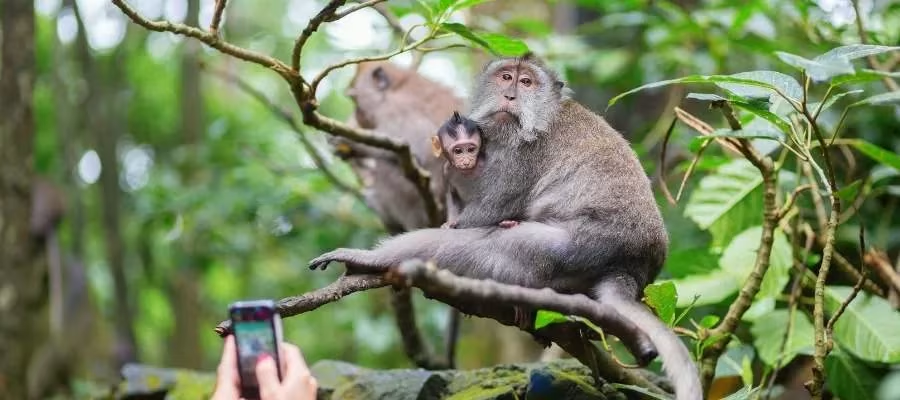
Do not disturb or touch them
Aside from the fact that they remain wild animals, monkeys can actually die from bacteria transmitted by your hand.
Because monkeys live in a very different environment than we do, they are exposed to different types of bacteria. If they are exposed to a foreign bacteria, such as the one that could come from your hands, they may not have the proper defense system to fight it and are more likely to get sick and die.
Therefore, if you have the opportunity to be around monkeys: look, but do not touch.
Do not feed them
If a monkey receives food from a human, it assumes that the next time it sees a person with food, it will get some. If it doesn't get what it wants, it will automatically become aggressive.
So keep your food to yourself and don't induce aggressive behaviour in our monkey friends.
How to avoid aggression
The first piece of advice we give you is to keep your distance.Monkeys are everywhere in Costa Rica, including national parks and local trees. They look cute and cuddly and may even approach you. Take a picture and admire them but don't try to pet or feed them. They may feel threatened and react aggressively. Also, human food can cause them health problems.
Also, keep an eye on your belongings as they may try to steal them.
Final thoughts: more than monkeys!
Monkeys may steal the spotlight in Costa Rica, but they’re only part of the story. As you explore the country’s parks and reserves, you’ll likely come across curious coatis rummaging along the trails or sloths lazily hanging in the treetops, each encounter as memorable as spotting a troop of capuchins or howler monkeys at dawn.
Want to maximize your wildlife sightings? The best reserves are spread out across the country, and having your own rental car from San José or Liberia makes it easy to chase the calls of howlers in the morning, watch sloths in the afternoon, and end the day with coatis crossing your path.